

Personal Strategy Compass Issue #11: October 2025
The Strategic Probe: What to Do in the Space After 'No'

Personal Strategy Compass Issue #11: October 2025
The Strategic Probe: What to Do in the Space After ‘No’
A quick note for my premium subscribers:
This month, I’m running a small experiment aligned with our theme of ‘strategic probes.’ I’m making the most of the main body of this issue available to all readers for the first time. I’m doing this because the topic feels especially universal, and my hope is to grow our community.
I want to assure you that this doesn’t devalue your subscription. I’ve always believed the AI Strategy Corner is the most powerful, actionable tool in the Compass, and in my view, its value alone is worth the price of admission. You, of course, have access to everything, including this month’s powerful prompt.
If you agree and find this issue valuable, I’d be grateful if you would share it with friends or colleagues who you think would benefit from this discussion. Thank you for being a core part of this community.
TABLE OF CONTENTS
Welcome & Introduction
The Hidden Risk of Standing Still
Ask Me Anything: Managing Transition Risk
Personal Reflection: My ‘Yes’ to Strategic Wandering
Activation Toolkit: Your KIPL Probe Worksheet
Tip of the Month: Probe vs. Plunge
PQO as a Practice: Your Quarterly VC Meeting
Recommended Resource
Closing Thoughts & The Explorer’s Manifesto
[PREMIUM SUBSCRIBERS ONLY] AI Strategy Corner: One Section Worth the Price of Admission Alone
Welcome & Introduction
The Peril of the Blank Slate
Saying no is a relief. It’s a clearing. A clean slate. For a moment, it feels like absolute freedom.
Then, a quiet panic can set in. I call it The Void. The space you fought so hard to create can feel less like an opportunity and more like an unnerving silence. We’ve been conditioned to be busy, and a blank calendar can be deeply unsettling.
The common advice is to wait for a “Hell Yes!” But what if that’s a trap? How many times have you actually seen an unreserved “Hell Yes!” in the wild? And if you saw one, would you say, “Hell Yes!” without doing your due diligence?
This issue offers a different path for your Personal Quarterly Offsite (“PQO”) practice. It’s an explicit permission slip to be messy and non-linear.
We’re going to invert the logic of Issue #10. If the “Strategic No” was about simplification, this is about strategic exploration. This is about the Strategic Probe. That’s a small, intelligent “yes” that generates a Return on Information and is the only real antidote to analysis paralysis.
The Hidden Risk of Standing Still
Inverting the Cost of Yes
Last month, we audited the hidden costs of saying yes rather than saying “no” strategically. Now, let’s examine the hidden risks of standing still.
From “Commitment Debt” to “Opportunity Cost.” Every no to exploration accrues an Opportunity Cost. By waiting for the perfect option, you are paying a steep price: the loss of new knowledge and the stagnation of your identity.
From “Cost of Carrying” to the “Risk of Rusting.” We talked about the mental load of carrying old commitments. The inversion is the Risk of Rusting in place. An identity built on being an “innovator” cannot be sustained by inaction. Without new learning curves, your core capabilities can atrophy.
From Pruning to Seeding. The CEO prunes. The Venture Capitalist seeds. Your job has changed. It’s no longer about ruthless efficiency; it’s about intelligent discovery. Your role is to make small investments of time and energy in a portfolio of potential futures.
Taken together, these three inversions reveal a critical truth: the riskiest move is not making a bad bet, but failing to make any bets at all. The strategic imperative is not to find the one perfect “Hell Yes!” Instead, it is to begin building a portfolio of small, intelligent probes. The following sections provide the frameworks to do just that.
Ask Me Anything: Managing Transition Risk
Tackling the Biggest Barrier to Your Next Chapter
Q: “I’ve used the Strategic No to clear my plate, but I still feel anxious about leaving my high-income partner role for an encore career. How does the PQO help me manage the financial and identity risk associated with winding down a practice I spent 30 years building?”
A question I often hear from high-achieving senior lawyers is: “How do I make a change without risking everything I’ve built?” This is where the PQO shifts from a planning tool to a risk-mitigation dashboard. We don’t leap; we build a bridge, one quarterly plank at a time. Your PQO is where you de-risk the transition by running small, low-cost experiments. Instead of quitting to become a consultant, you use one PQO cycle to land a single, paid pilot project. You test the market, your messaging, and your own enthusiasm for the work before making an irreversible decision.
Financially, the PQO is where you model the future. You define the specific revenue targets your “encore career” needs to hit and work backward, setting quarterly milestones. This transforms a terrifying financial unknown into a manageable, measurable project. Identity risk is managed the same way. Use your PQO to intentionally build your new identity (e.g., “Board Advisor”) through concrete actions long before you shed the old one. Remember, your PQO is the place where you have permission and space to create Risk-Managed Transition Plans, ensuring your legacy and your financial stability are protected throughout your strategic career evolution.
Personal Reflection: My ‘Yes’ to Strategic Wandering
Why I Had to Get Comfortable with Being Uncomfortable
After retiring from Michigan State University, my instinct, honed over decades, was to immediately engineer a master plan. My PQO, however, led me to a counter-intuitive conclusion: the most strategic “yes” I could make was a “yes” to not knowing.
I took a solo camping trip on my family’s farm immediately after my last day at MSU a few weeks ago. My instinct was to pull out a notebook and force a plan and resisting that urge was surprisingly difficult. That discomfort was the whole point. It was an act of strategic wandering, allowing me to detach from the need for certainty. The big “yes” wasn’t to a project. Instead, it was to a process of exploration. I’ll be drawing from the lessons I learned on that camping trip for a long time to come.
Activation Toolkit: Your KIPL Probe Worksheet
A 4-Quadrant Matrix for Designing Safe-to-Fail Experiments
The best way to move forward is to manage a portfolio of small, safe-to-fail experiments. Use this matrix to map out your probes. Your goal is to focus on the “Smart Probes” quadrant.
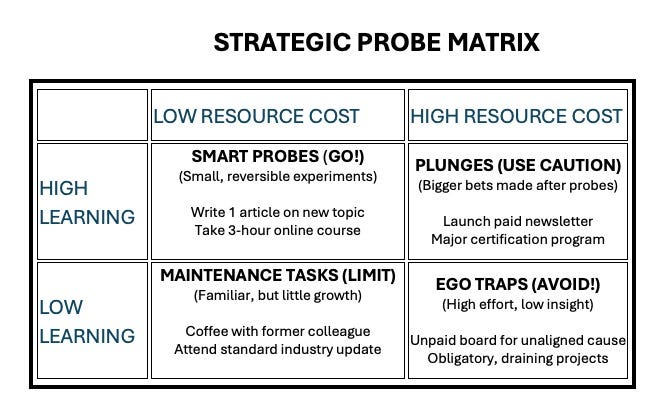
A Probe in Practice: Let’s say your hypothesis is to become a board advisor. A ‘Smart Probe’ isn’t applying to boards; it’s having one 30-minute call with a search firm recruiter to learn about the market. Cost: 1 hour. Return on Information: Massive. The “plunge” step might be to read a whole board on serving on a board or even applying for two board positions to gather data.`
Tip of the Month: Probe vs. Plunge
Before committing to a new “yes,” ask this one question: “Is this a probe or a plunge?” A probe is a small, reversible experiment designed to get information. A plunge is a large, hard-to-reverse commitment. This season of your career is for probing, not plunging, first.
PQO as a Practice: Your Quarterly VC Meeting
Reframe your Personal Quarterly Offsite. It is now your Quarterly Venture Capital Meeting. This is where you:
1. Review the Portfolio: Assess learnings from last quarter’s probes.
2. Kill, Pivot, or Persevere: Decide which bets to abandon, modify, or double-down on.
3. Allocate New Capital: Approve a new “seed fund” of time for the next quarter’s portfolio of Smart Probes.
There is the start of your next PQO agenda.
Recommended Resource
Disrupt Yourself: Putting the Power of Disruptive Innovation to Work by Whitney Johnson. This is the essential guide to applying the S-Curve framework, famous in business innovation, to your own career trajectory. Johnson brilliantly reframes career growth as a series of learning curves we must intentionally jump between to avoid stagnation. It’s a perfect strategic companion for anyone designing their next chapter and a great framework for thinking about smart probes.
Closing Thoughts & The Explorer’s Manifesto
The ultimate freedom of the “Strategic Yes” isn’t refilling your calendar with new tasks. It’s earning the capacity to place your own bets.
The Manifesto for the Strategic Explorer:
Value learning over certainty.
Favor probes over plunges.
Gather data, don’t just introspect.
Seek a Return on Information.
Embrace the messy middle.
This points us to a new operating system for this season of your professional life. For decades, our success was defined by having the right answers and a clear five-year plan. The work now is to get comfortable asking the right questions and running the small, reversible experiments that bring back valuable data. Your next great chapter won’t be revealed in a flash of magical “Hell Yes!” insight. It will be assembled, piece by piece, from the knowledge you gain with your very next probe.
A strategic probe is the purest expression of your curiosity.
